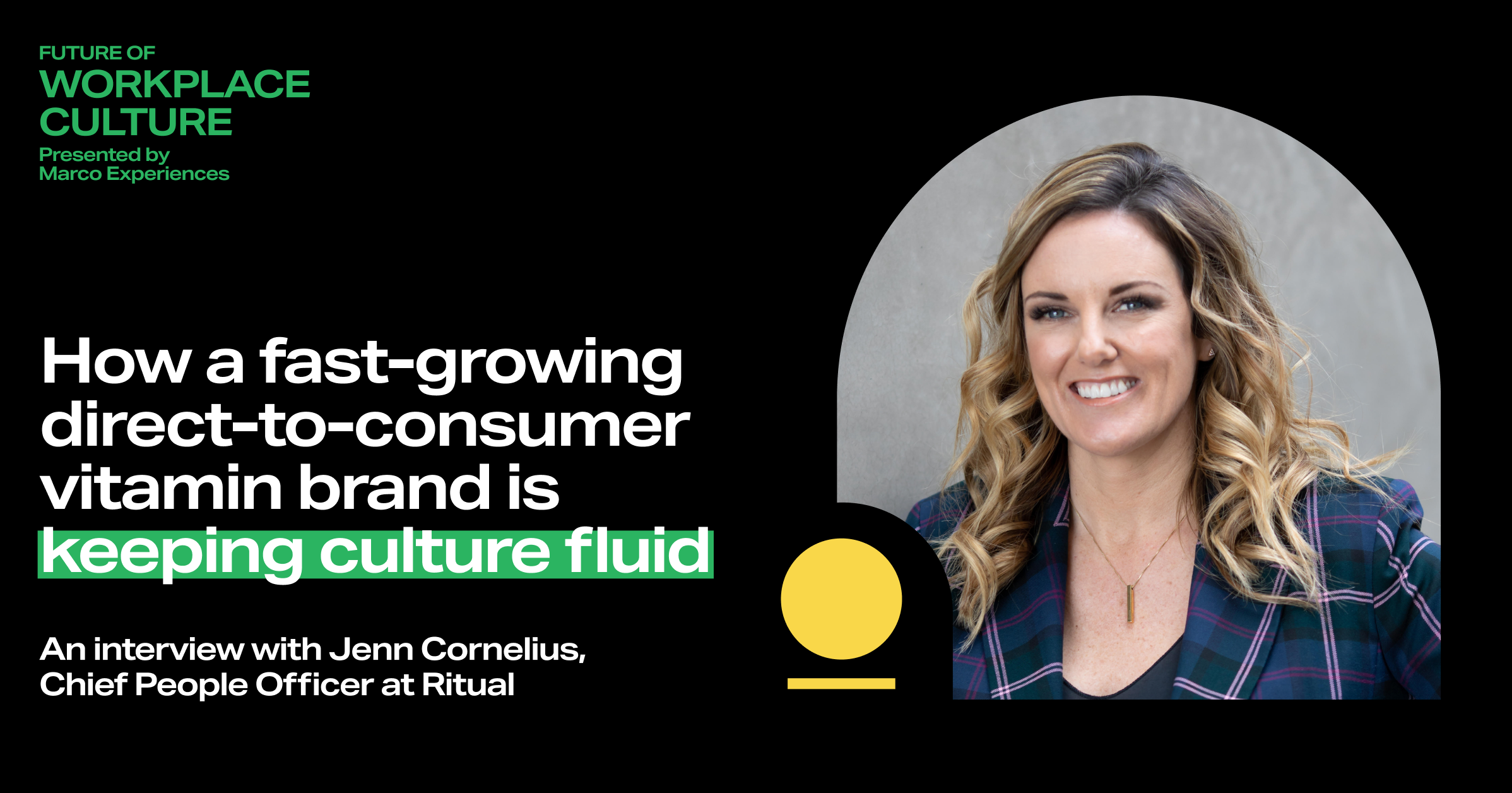
In Episode 6 of Marco Labs, we sat down with Jenn Cornelius, Chief People Officer at Ritual, the direct-to-consumer health brand known for its transparent approach to vitamins and supplements. Jenn's career spans Apple, Sweetgreen, and her own consulting practice - giving her a rare perspective on what it takes to build culture at every stage of company growth.
This conversation is essential reading for anyone trying to build authentic company culture - especially leaders at fast-growing companies where the culture you have at 50 people is about to be tested at 200.
The Career Path That Shaped a People Leader
Jenn's journey to Chief People Officer didn't follow the typical HR track. She started in operations - a sales associate at a clothing store who fell in love with customer service. That operational lens became the foundation for everything that came after.
At Starbucks, she learned what a world-class employee experience looks like in practice. At Apple, she spent over a decade in HR, developing deep expertise in organizational development and effectiveness. Working across Apple's complex vertical structure taught her to think about people as assets, not headcount.
Then life intervened. While at Apple, Jenn experienced the most transformative personal events of her career - including the loss of her daughter in 2017. That experience fundamentally changed how she thought about work, priorities, and what it means to show up as a whole person.
She left Apple for Sweetgreen, becoming Chief People Officer for the first time. Then the pandemic hit. She took time off, started a consulting practice called Simple Collective, and eventually landed at Ritual - a company that matched her values around transparency, health, and intentional growth.
What "Culture" Actually Means
Ask ten people leaders to define culture and you'll get ten different answers. Jenn's definition cuts through the abstraction:
"Culture is how you show up. It's how you behave. You can walk into a room - whether it's a dinner party or a team meeting - and see how people are interacting, the look on their face, the body language. That tells you everything about culture."
For Jenn, culture isn't a document or a set of perks. It's the observable reality of how people treat each other, make decisions, and navigate conflict. And critically, it's not one person's job to create.
Why Culture Is Everyone's Job
One of Jenn's strongest convictions is that culture can't be owned by the CPO or the People team alone. It's a shared responsibility that lives in every interaction, every meeting, every decision.
"Everybody in an organization has a responsibility to contribute to the culture. They're actively engaging with each other day to day, and it can be a positive force for change with every decision we make. Culture is going to be the thing that makes or breaks a company."
This doesn't mean the People team isn't instrumental. They set the conditions - the rituals, the norms, the systems - that make great culture possible. But the actual culture emerges from how every person in the organization chooses to show up.
Bringing Your Whole Self to Work
The concept of "bringing your whole self to work" has become a corporate cliché, but Jenn lives it with an authenticity that's unmistakable. Her personal experience - losing a child, navigating career changes as a working mother, making decisions based on family priorities - informs how she leads.
"It's really important to me that organizations value the people that they are, and allow humans to be humans. We need to create a safe space - ideally a brave space, if I'm quoting Brené Brown - that tells people to show up and be their whole self."
At Ritual, this shows up in practical ways: flexible work arrangements that acknowledge people's lives outside work, a hiring process that explores who candidates are as people (not just their resumes), and a leadership team that models vulnerability and transparency.
Best-in-Class Should Permeate Everything
When companies talk about being "best-in-class," they usually mean their product or their revenue. Jenn argues the standard should apply to everything - including how you treat your people, run meetings, onboard new hires, and design your workspace.
"It's in everything you do - you're seeking to continuously improve and be incredible in your space."
At Ritual, this philosophy is baked into the brand's DNA. The same transparency and traceability they bring to their vitamin ingredients, they bring to their internal culture: clear communication about company direction, transparent feedback processes, and a commitment to continuously improving the employee experience.
Scaling Culture from 100 to 500
When Jenn joined Ritual, the company had around 110 employees and had just hired 65 people in one year. That kind of growth is where culture either solidifies or fractures. The challenge isn't maintaining culture at 100 - it's building the infrastructure that preserves what's special while you scale.
Jenn's approach to this challenge draws directly from her operations background:
- Systems that encode culture: The values, rituals, and norms that make your culture distinctive need to be documented, repeated, and embedded in your processes - from onboarding to performance reviews to how you run all-hands meetings.
- Personal connection at scale: When Jenn started at Ritual, she made it a personal mission to have a coffee chat with every single employee. At 100 people, that's possible. At 500, it requires different mechanisms - but the intent matters.
- Manager quality as a culture lever: The relationship between an employee and their manager is the single strongest predictor of engagement, retention, and cultural alignment. Investing in manager development is investing in culture.
The Hybrid Work Experiment
Like many companies, Ritual has embraced a hybrid model. But Jenn is thoughtful about not pretending there's a one-size-fits-all answer. The team is staying fluid - observing, listening to feedback, and making changes as they learn.
Her key insight: many employees are happy doing focused work at home and coming into the office specifically for socializing and collaboration. This means the office isn't the place for heads-down work anymore - it's a gathering space designed for the interactions that benefit from being in person.
For People leaders navigating the same challenge, Jenn's advice is practical: experiment actively, check in on sentiment regularly, and accept that culture in a hybrid world is a moving target that requires constant attention.
The Future of the CPO Role
Jenn sees the Chief People Officer role expanding well beyond traditional HR. With the shift to remote and hybrid work, CPOs are now thinking about organizational design, performance systems, technology adoption, and even physical space strategy - areas that used to sit entirely with operations or IT.
She's especially excited about the intersection of people strategy and technology - AI-driven insights into engagement, new tools for remote onboarding, platforms that help distributed teams maintain connection. The CPO of the future, she argues, needs to be as comfortable with technology and data as they are with empathy and culture.
Key Takeaways for People Leaders
- People bring their whole selves to work - whether you acknowledge it or not. Build a culture that makes space for the full human, not just the employee.
- Culture is everyone's job. The People team creates the conditions; every employee creates the reality.
- Best-in-class applies to everything. Don't just build a great product - build a great employee experience, a great hiring process, a great feedback culture.
- Scaling requires infrastructure. What works at 50 people won't work at 200. Build the systems now that will preserve your culture as you grow.
- Hybrid work is an ongoing experiment. Don't lock in a model - stay fluid, listen to your team, and be willing to change.
Marco Labs is our podcast series featuring in-depth conversations with the people shaping the future of work, culture, and community. Explore all episodes.
Want to build culture through intentional team gatherings? Take our retreat quiz and let Marco help you plan an offsite that strengthens your team.
Frequently Asked Questions
What is Marco Labs?
Marco Labs is a podcast series by Marco Experiences featuring conversations with founders, people leaders, and culture builders. Each episode explores how leaders build culture, connection, and community in their organizations.
What role does Jenn Cornelius hold?
Jenn Cornelius is the Chief People Officer at Ritual, a direct-to-consumer health brand. She previously held HR leadership roles at Apple and Sweetgreen, and founded Simple Collective, a people strategy consulting firm.
What is the main takeaway from this episode?
Culture isn't owned by the CPO or the People team - it's a shared responsibility that lives in every interaction. The best companies make culture everyone's job while investing in the systems and rituals that scale it.
How does this relate to company retreats and offsites?
Jenn's insights about intentional culture-building map directly to the purpose of offsites and retreats. In-person gatherings are one of the most powerful tools for reinforcing culture, building the personal connections that Jenn prioritizes, and creating the "brave spaces" she describes.