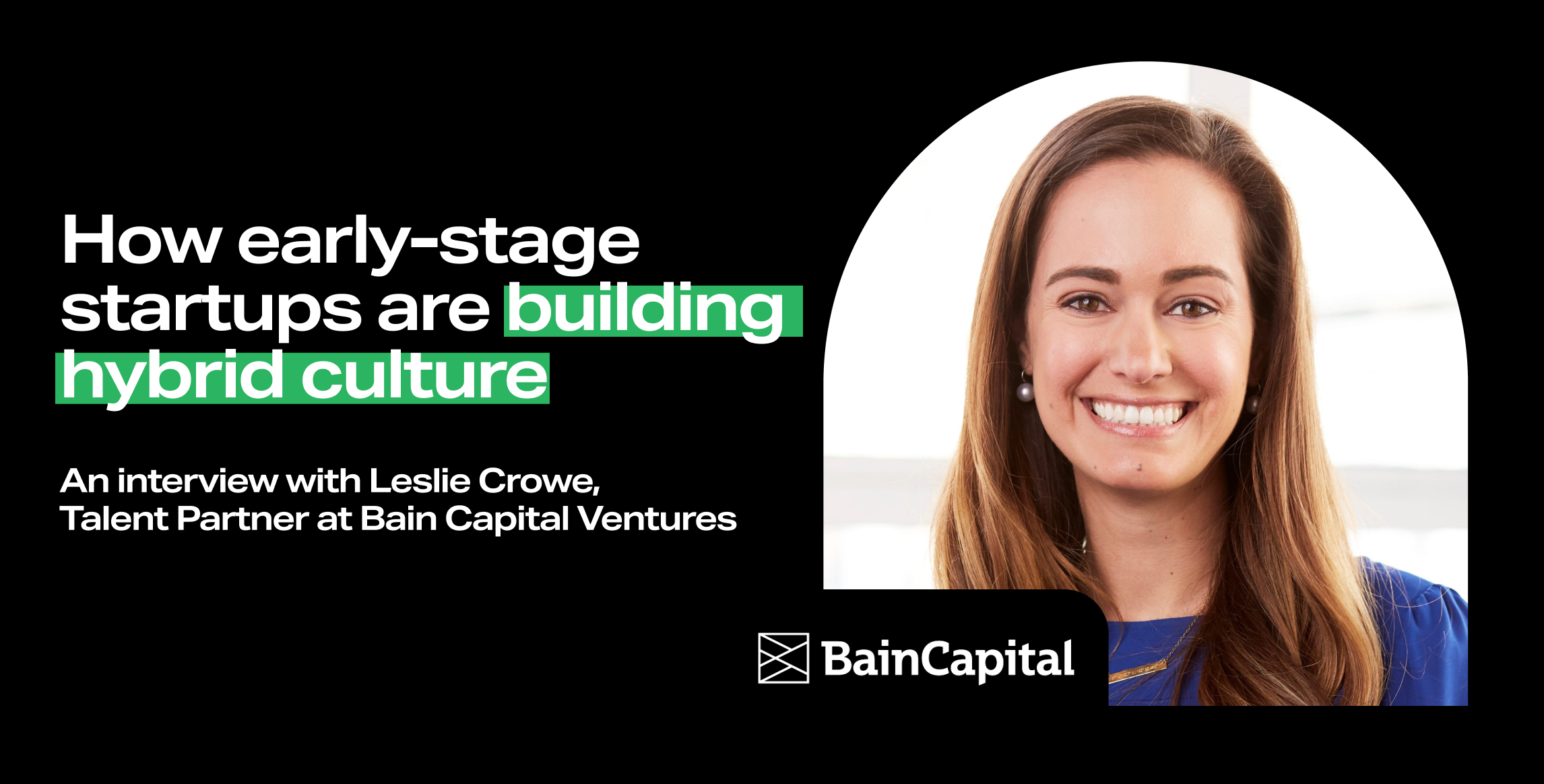
Leslie Crowe is a Talent Partner at Bain Capital Ventures, where she works with a portfolio of over 200 companies on building teams and culture. In this episode of Marco Labs, she spoke with Marco's Suman Siva about the trends she's seeing across early-stage startups when it comes to culture, the rise of geographic hubs, and why in-person experiences are becoming more important, not less.
With visibility into hundreds of startups at once, Leslie has a unique vantage point on what's actually working in team culture right now - not in theory, but in practice across diverse companies and industries.
The Rise of Geographic Hubs
One of the most interesting trends Leslie is seeing across the Bain Capital Ventures portfolio is the adoption of geographic hubs. Rather than returning to a single headquarters, many companies are establishing specific locations within commutable distance that serve as gathering spaces.
These hubs aren't designed to be full-time offices. They're designed for in-person collaboration and connection - a place teams can come together when being face-to-face matters, without requiring everyone to relocate to a single city.
For companies considering this model, the key insight is that the hub needs to be worth the commute. Having a WeWork with some desks isn't enough. The space needs to feel intentional, and the time spent there needs to be structured for the kind of work that genuinely benefits from being in the same room.
In-Person Experiences Are Growing in Importance
With more teams operating remotely or in hybrid arrangements, the moments when people are physically together carry more weight than they used to. Leslie sees this clearly across the portfolio.
"Companies will have, in a way that they didn't before, really aggressive yet thoughtful planning around in-person experiences."
This doesn't mean going back to the office five days a week. It means being more strategic and intentional about when and how teams gather. Annual retreats, quarterly offsites, and team-specific gatherings are replacing the passive togetherness of an open office with deliberate, high-impact connection time.
The Companies Winning Are Leaning Into Flexibility
Flexible work comes with enormous opportunities, and the companies best positioned to succeed are those that lean into these trends rather than fighting them. That said, Leslie is clear: building a distributed company isn't for everyone.
"Don't build a company you're not going to like. It's really up to the founder."
The honest takeaway is that remote and hybrid models require a different kind of leadership. They require more intentionality around communication, more investment in team gatherings, and more trust in your people. If a founder fundamentally believes teams need to be in the same room every day, forcing a hybrid model will create more problems than it solves.
Culture Is Not a Catch-All Term
Leslie makes an important distinction: "culture" can be used as a catch-all that actually excludes people rather than including them. When companies say someone isn't a "culture fit" without being specific about what that means, they're often masking bias or unclear thinking.
"If you're using blanket statements like 'you're not a culture fit,' that can be the death of culture if you aren't spending time to unwind what that means."
The better approach is to define your culture in concrete, observable terms. What behaviors do you value? What does collaboration actually look like at your company? What does success in this role require beyond technical skills? When you can answer these questions specifically, "culture fit" becomes a meaningful criterion rather than a vague feeling.
Building Culture in Early-Stage Startups
For early-stage companies without dedicated People teams, Leslie's advice is to start with the basics:
- Be explicit about your values early. Don't wait until you're 50 people to define what matters. The first 10 hires set the cultural foundation for everything that follows.
- Invest in gathering before you can "afford" it. Early-stage companies that bring their team together regularly - even when budgets are tight - build stronger cultural DNA than those that wait until they've raised a Series B.
- Hire for what you need, not who you know. Early-stage hiring often relies on networks, which can create homogeneous cultures. Be intentional about building a team that brings diverse perspectives.
- Document your operating norms. How do you make decisions? How do you communicate asynchronously? How do you handle conflict? Writing these down early creates clarity as the team scales.
What This Means for Retreat Planning
Leslie's insights have direct implications for how companies approach team gatherings:
- Offsites are strategic, not recreational. In a distributed world, retreats are the primary vehicle for building the trust and alignment that used to happen organically in an office.
- Frequency matters. One annual retreat isn't enough for most distributed teams. Quarterly touchpoints, even smaller ones, maintain the connection between major gatherings.
- Early investment pays off. The startups in Bain's portfolio that invest in team gathering early build stronger cultures that scale better.
Ready to invest in your team's culture? Take our retreat quiz and Marco will help you plan a gathering that builds the foundation your team needs.
Frequently Asked Questions
What are geographic hubs and how do they work for distributed teams?
Geographic hubs are designated physical spaces in specific cities where distributed team members can gather for in-person collaboration. Unlike traditional offices, they're not designed for daily use but for intentional gatherings - team meetings, collaborative workshops, and social connection.
How often should early-stage startups hold team retreats?
According to patterns across Bain Capital Ventures' portfolio, the most successful early-stage startups invest in at least quarterly in-person gatherings, even when budgets are tight. These don't need to be elaborate - a 2-day offsite can be highly effective if well-designed.
What does "culture fit" actually mean in hiring?
Leslie Crowe argues that "culture fit" should refer to specific, observable values and behaviors rather than a vague feeling. Companies should define their culture in concrete terms - communication styles, decision-making approaches, collaboration norms - and evaluate candidates against those specifics.
How can distributed companies build strong culture without an office?
The key elements are: explicit values defined early, regular in-person gatherings (retreats, offsites, hub meetups), documented operating norms, and intentional investment in connection. Companies that treat culture as something that requires active maintenance outperform those that assume it will develop on its own.